Learn the Basics || Quick Start || Dataset & Data Structure || Learning Part || Reasoning Part || Evaluation Metrics || Bridge
Dataset & Data Structure
In this section, we will look at the dataset and data structure in ABLkit.
import torch
from ablkit.data.structures import ListData
Dataset
ABLkit requires user data to be either structured as a tuple (X, gt_pseudo_label, Y) or a ListData (the underlying data structure utilized in ABLkit, cf. the next section) object with X, gt_pseudo_label and Y attributes. Regardless of the chosen format, the data should encompass three essential components:
X: List[List[Any]]A list of sublists representing the input data. We refer to each sublist in
Xas an example and each example may contain several instances.gt_pseudo_label: List[List[Any]], optionalA list of sublists with each sublist representing ground-truth pseudo-labels of an example. Each pseudo-label in the sublist serves as ground-truth for each instance within the example.
Note
gt_pseudo_labelis only used to evaluate the performance of the learning part but not to train the model. If the pseudo-label of the instances in the datasets are unlabeled,gt_pseudo_labelshould beNone.Y: List[Any]A list representing the ground-truth reasoning result for each example in
X.
Warning
The length of X, gt_pseudo_label (if not None) and Y should be the same. Also, each sublist in gt_pseudo_label should have the same length as the sublist in X.
As an illustration, in the MNIST Addition task, the data are organized as follows:
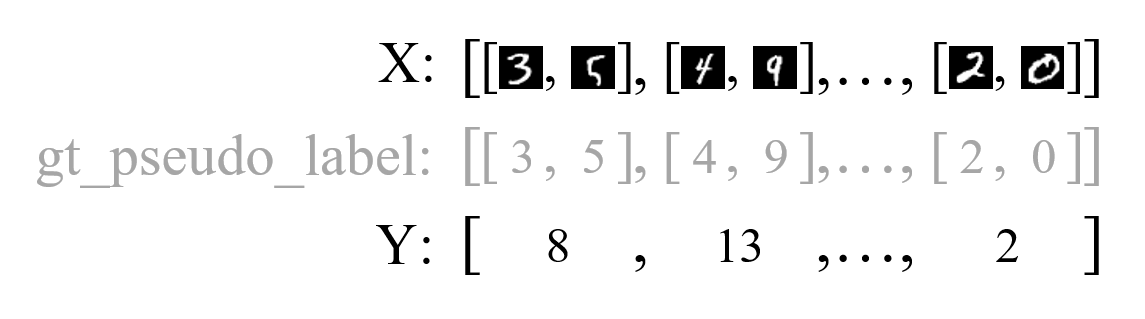
where each sublist in X, e.g.,  , is a data example and each image in the sublist, e.g.,
  , is an instance.
Data Structure
Besides the user-provided dataset, various forms of data are utilized and dynamicly generated throughout the training and testing process of ABL framework. Examples include raw data, predicted pseudo-label, abduced pseudo-label, pseudo-label indices, etc. To manage this diversity and ensure a stable, versatile interface, ABLkit employs abstract data interfaces to encapsulate different forms of data that will be used in the total learning process.
ListData is the underlying abstract data interface utilized in ABLkit. As the fundamental data structure, ListData implements commonly used data manipulation methods and is responsible for transferring data between various components of ABL, ensuring that stages such as prediction, abductive reasoning, and training can utilize ListData as a unified input format. Before proceeding to other stages, user-provided datasets will be firstly converted into ListData.
Besides providing a tuple of (X, gt_pseudo_label, Y), ABLkit also allows users to directly supply data in ListData format, which similarly requires the inclusion of these three attributes. The following code shows the basic usage of ListData. More information can be found in the API documentation.
# Prepare data
X = [list(torch.randn(3, 28, 28)), list(torch.randn(3, 28, 28))]
gt_pseudo_label = [[1, 2, 3], [4, 5, 6]]
Y = [1, 2]

# Convert data into ListData
data = ListData(X=X, Y=Y, gt_pseudo_label=gt_pseudo_label)

# Get data
X = data.X
Y = data.Y
gt_pseudo_label = data.gt_pseudo_label

# Set data
data.X = X
data.Y = Y
data.gt_pseudo_label = gt_pseudo_label