Learn the Basics || Quick Start || Dataset & Data Structure || Learning Part || Reasoning Part || Evaluation Metrics || Bridge
Learn the Basics
Modules in ABLkit
ABLkit is an efficient toolkit for Abductive Learning (ABL), a paradigm which integrates machine learning and logical reasoning in a balanced-loop. ABLkit comprises three primary parts: Data, Learning, and Reasoning, corresponding to the three pivotal components of current AI: data, models, and knowledge. Below is an overview of the ABLkit.
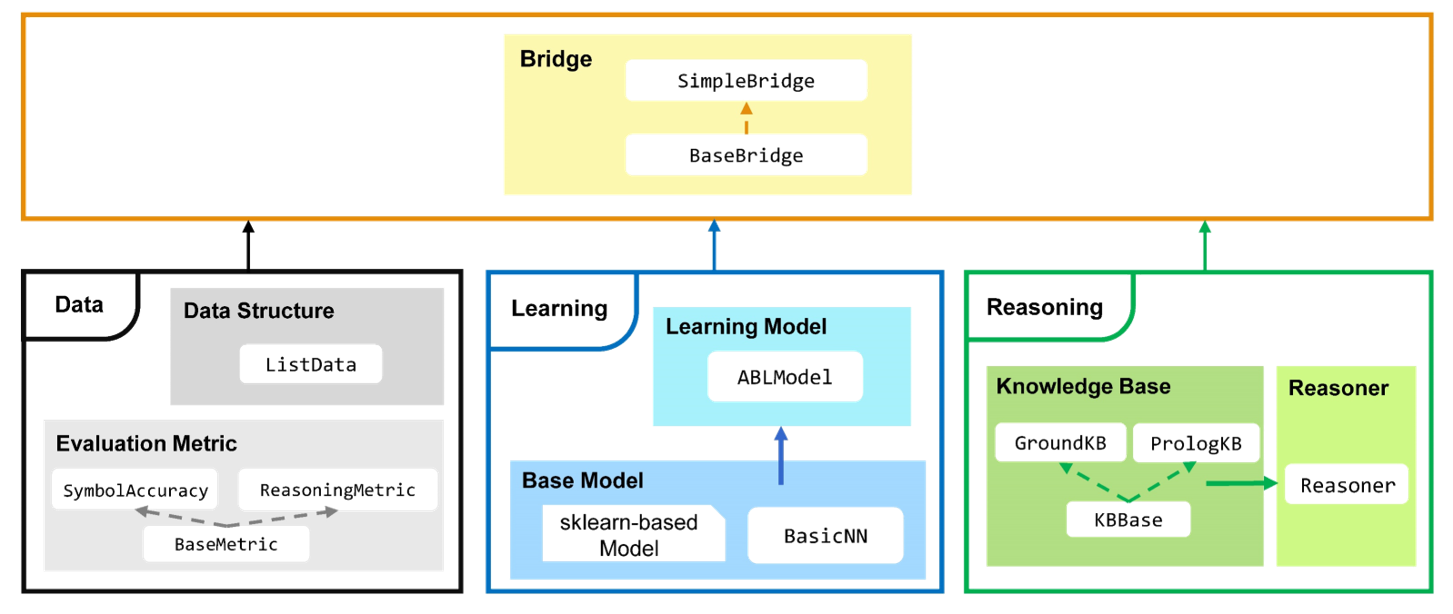
Data part efficiently manages data storage, operations, and evaluations.
It includes the ListData class, which defines the data structures used in
ABLkit, and comprises common data operations like insertion, deletion,
retrieval, slicing, etc. Additionally, it contains a series of evaluation metrics
such as SymbolAccuracy and ReasoningMetric (both specialized metrics
inherited from the BaseMetric class), for evaluating performance from a
data perspective.
Learning part focuses on creating, training, and utilizing
machine learning models. The ABLModel class is the
central class that encapsulates the machine learning model. This class is
compatible with various frameworks, including those based on scikit-learn
or PyTorch neural networks constructed by the BasicNN class.
Reasoning part concentrates on constructing domain knowledge and
performing reasoning. The KBBase class allows users to customize a
domain knowledge base. For diverse types of knowledge, we also offer
implementations like GroundKB and PrologKB (both inherited
from the KBBase class). The latter, for instance, imports
knowledge bases via Prolog files. Upon building the knowledge base,
the Reasoner class is responsible for minimizing the inconsistency
between the knowledge base and data.
The integration of these three parts is achieved through the
Bridge part, which features the SimpleBridge class (derived
from the BaseBridge class). The Bridge part synthesizes data,
learning, and reasoning, facilitating the training and testing
of the entire ABL framework.
Use ABLkit Step by Step
In a typical ABL process, as illustrated below,
data inputs are first predicted by the learning model ABLModel.predict, and the outcomes are pseudo-labels.
These labels then pass through deductive reasoning of the domain knowledge base KBBase.logic_forward
to obtain the reasoning result. During training,
alongside the aforementioned forward flow (i.e., prediction –> deduction reasoning),
there also exists a reverse flow, which starts from the reasoning result and
involves abductive reasoning KBBase.abduce_candidates to generate possible revised pseudo-labels.
Subsequently, these pseudo-labels are processed to minimize inconsistencies with the learning part.
They in turn revise the outcomes of the learning model, which are then
fed back for further training ABLModel.train.
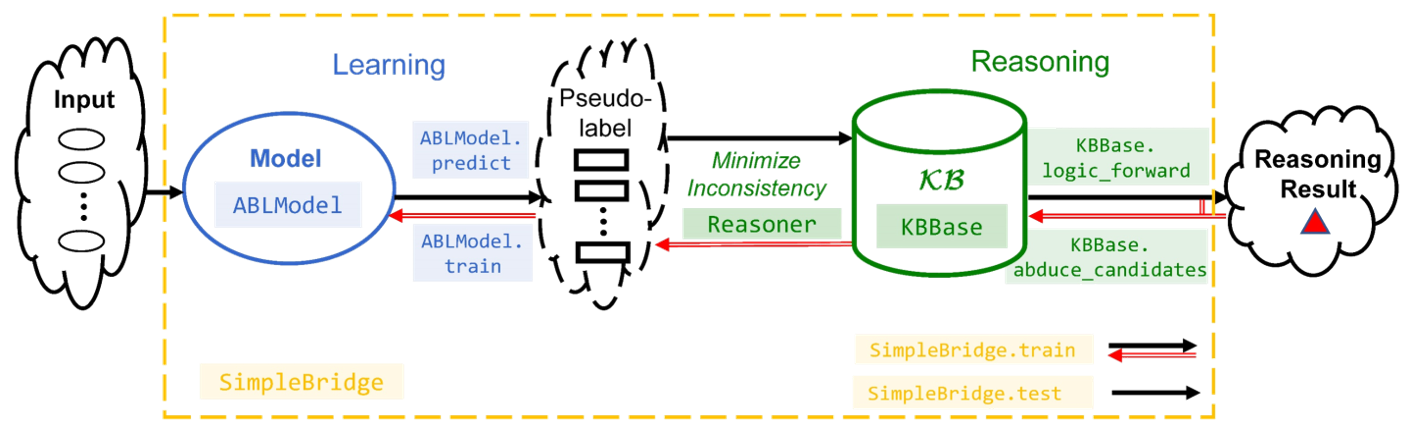
To implement this process, the following five steps are necessary:
Prepare datasets
Prepare the data’s input, ground truth for pseudo-labels (optional), and ground truth for reasoning results.
Build the learning part
Build a machine learning base model that can predict inputs to pseudo-labels. Then, use
ABLModelto encapsulate the base model.Build the reasoning part
Define a knowledge base by building a subclass of
KBBase, specifying how to process pseudo-labels to reasoning results. Also, create aReasonerfor minimizing inconsistencies between the knowledge base and data.Define evaluation metrics
Define the metrics by building a subclass of
BaseMetric. The metrics will specify how to measure performance during the training and testing of the ABL framework.Bridge learning and reasoning
Use
SimpleBridgeto bridge the learning and reasoning part for integrated training and testing.